


<< Return to regional settings
SET.AC.RE.DT. Regional date and time settings
For selling on marketplaces (Amazon, eBay, Zalando, Etsy, etc.) in Europe, correctly setting the time zone plays a crucial role, as the platform, customers, and logistics providers may be located in different time zones. This is essential for meeting deadlines, optimizing processes, and accurately tracking order times.
Time zones
You can select the desired time zone from the dropdown list:
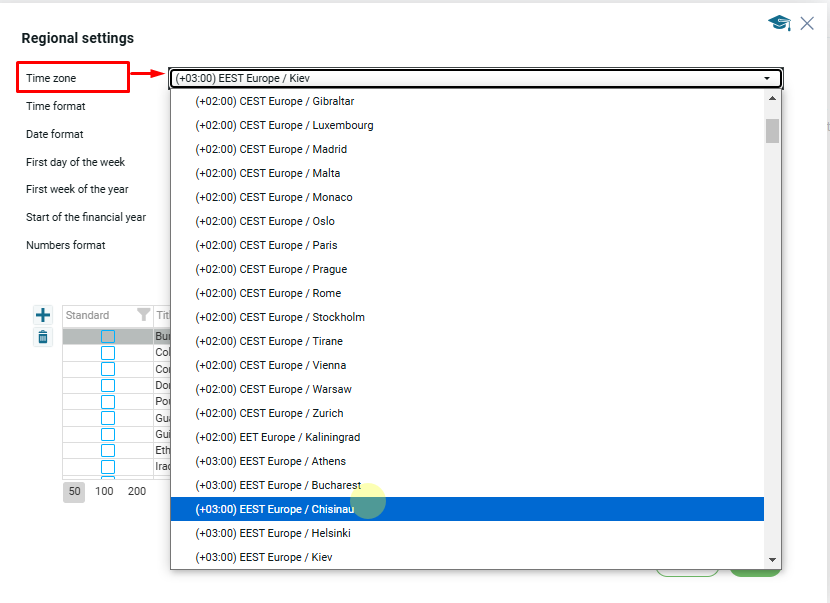
Take a look at the examples of working with time zones >>>
Key Time Zones of the World
- 1. UTC (Greenwich Mean Time): London, Reykjavik.
- 2. UTC+1 (Central European Time): Paris, Berlin, Rome, Madrid
- 3. UTC+3 (Moscow Time): Moscow, Minsk, Istanbul
- 4. UTC+5:30 (Indian Standard Time): New Delhi, Mumbai
- 5. UTC+8 (China Standard Time): Beijing, Shanghai, Hong Kong, Singapore
- 6. UTC+9 (Japan Standard Time): Tokyo, Seoul
- 7. UTC-5 (Eastern Standard Time – US): New York, Washington, Toronto
Main time zones of Europe
- 1. UTC (Greenwich Mean Time): United Kingdom, Ireland, Portugal
- 2. UTC+1 (Central European Time, CET): France, Germany, Italy, Spain, Netherlands
- 3. UTC+2 (Eastern European Time, EET): Greece, Finland, Baltic States, Romania, Bulgaria
Most European countries observe daylight saving time, moving the clock forward by one hour in spring and returning to standard time in autumn.
Time format
You can select the desired time format from the dropdown list:
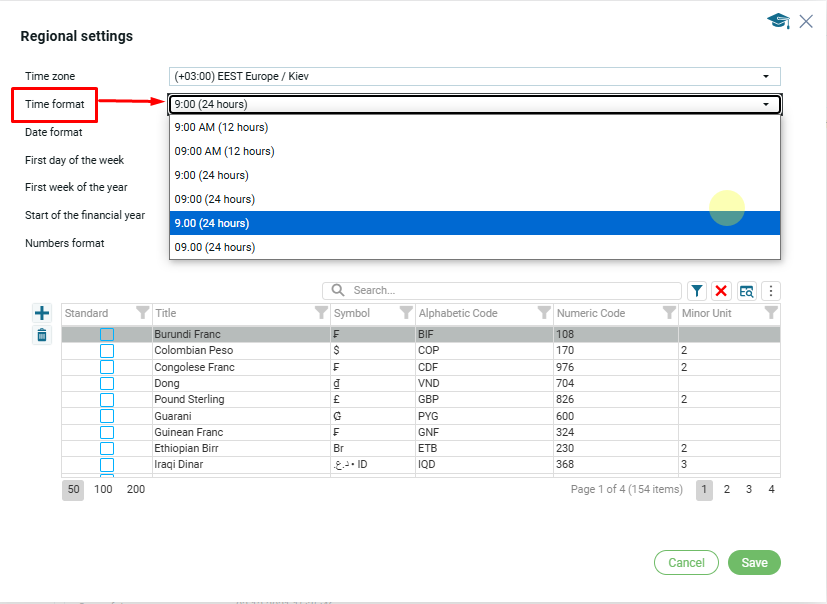
The time format defines how time is displayed and recorded across systems, documentation, and communications. It ensures accuracy, consistency, and clarity in all aspects of business operations, especially in international environments or when using automated systems.
Main time formats:
1. 24-hour format (HH:mm):
- Example: 14:30 (2 hours and 30 minutes in the afternoon)
- Used in: Most European countries, Russia, Asia
- Advantages:
- Eliminates ambiguity
- Convenient for automated systems
2. 12-hour format (hh:mm AM/PM):
- Example: 02:30 PM (2 hours and 30 minutes in the afternoon)
- Used in: USA, Canada, Australia
- Advantages:
- Easier to understand in informal settings
3. ISO 8601 (Global Standard):
Used in: International operations, IT, databases
Example: 2024-12-15T14:30:00Z (December 15, 2024, 14:30 UTC)
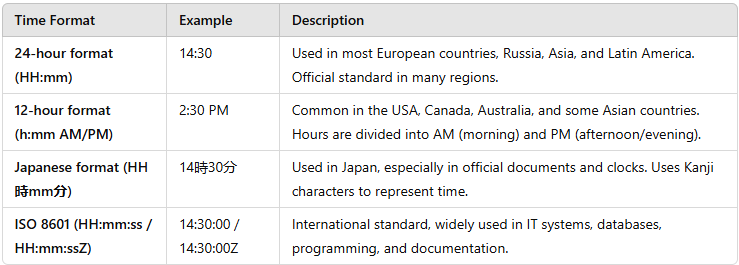
Take a look at the examples of how different time formats are used >>>
Date format
You can select the desired date format from the dropdown list:
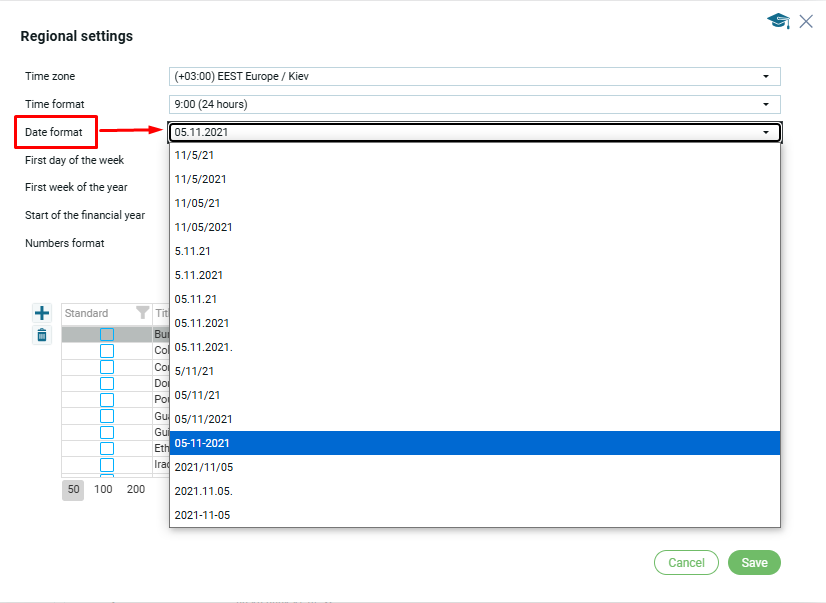
Date format refers to the way a date is displayed and structured in documents, accounting systems, and user interfaces. It plays a vital role in business operations by providing a consistent standard for recording, exchanging, and interpreting time-related data.
There are several major date formats used around the world, which vary depending on regional preferences, cultural practices, and local standards. All formats generally fall into three main categories: Day–Month–Year (DMY), Month–Day–Year (MDY), Year–Month–Day (YMD).
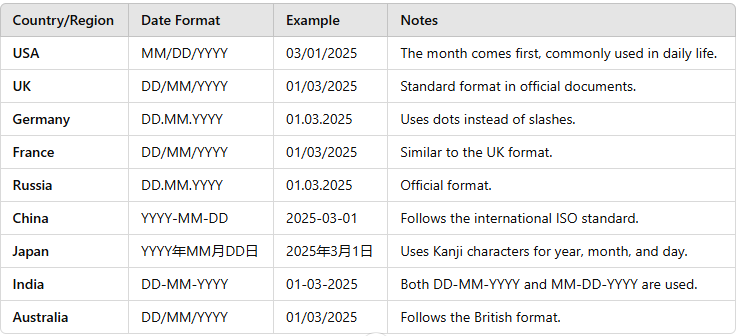
International Standard ISO 8601:
Example: 2024-05-12
Format: YYYY-MM-DD
This format is universal and recommended for use in international systems, databases, and document management.